
Do Not Make This OEM Knife Sourcing Mistake: Blade Finish
A Practical Guide for B2B Buyers on Choosing, Approving, and Controlling Kitchen Knife Blade Finishes When sourcing OEM kitchen knives, buyers often spend considerable time discussing steel grades, hardness, handle materials, packaging, logos, and price.
OEM LIBRARY
senmiao/DRAKZEN
7/5/20269 min read

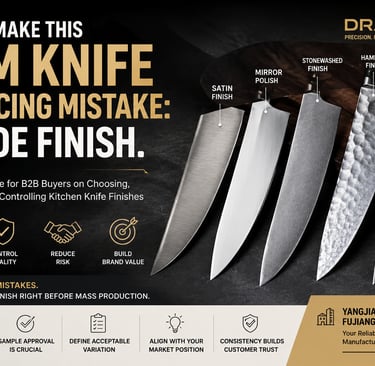
A Practical Guide for B2B Buyers on Choosing, Approving, and Controlling Kitchen Knife Blade Finishes
When sourcing OEM kitchen knives, buyers often spend considerable time discussing steel grades, hardness, handle materials, packaging, logos, and price.
Yet one specification is frequently underestimated:
Blade finish.
Terms such as satin finish, mirror polish, stonewashed finish, hammered finish, Damascus finish, and black coating may appear simple on a quotation sheet.
In production, however, blade finish is not merely a cosmetic choice.
It can influence product positioning, manufacturing cost, visual consistency, scratch visibility, logo appearance, quality inspection standards, packaging requirements, and customer expectations.
One of the most common OEM knife sourcing mistakes is approving a blade finish based only on a reference photo or a general description.
A buyer says:
“We want a satin finish.”
The manufacturer agrees.
The sample is produced.
Mass production begins.
Then the buyer discovers that the brushing direction, surface brightness, scratch pattern, grind marks, logo contrast, or finish consistency does not match what they expected.
The problem is rarely that one side intentionally changed the specification.
The real problem is that the blade finish was never defined precisely enough.
This guide explains what B2B buyers should evaluate before approving a kitchen knife blade finish, how different finishes affect manufacturing and commercial positioning, and how to establish clearer approval standards for OEM production.
Why Blade Finish Is More Important Than Many Buyers Realize
When consumers evaluate a kitchen knife, they rarely inspect the steel certificate or heat-treatment record first.
They see the product.
The blade surface is one of the first visual signals influencing perceived quality.
A well-executed finish can make a relatively simple knife look refined and professionally manufactured.
An inconsistent finish can make an expensive knife look poorly controlled.
For B2B buyers, this creates an important sourcing reality:
Blade finish is both a manufacturing specification and a brand specification.
A retailer may evaluate whether the product looks consistent on store shelves.
An e-commerce seller may care about whether the blade photographs well under studio lighting.
A premium brand may require precise surface texture and logo contrast.
A restaurant supplier may prefer a practical finish that hides scratches and is easier to maintain.
The correct blade finish depends on the product, target customer, price positioning, manufacturing process, and sales channel.
That is why simply writing “satin finish” or “mirror polish” on a purchase order is often not enough.
1. Never Approve a Blade Finish by Name Alone
The first mistake buyers should avoid is assuming that finish terminology is standardized across all factories.
It is not.
One manufacturer’s satin finish may be relatively bright with fine horizontal brushing.
Another manufacturer may use a coarser abrasive belt, creating a darker and more visible scratch pattern.
Both products may technically be described as “satin finished.”
The same problem applies to terms such as:
Mirror polished
Stonewashed
Hairline finish
Matte finish
Sandblasted
Hammered finish
Damascus finish
Blackened finish
Descriptions help communicate the general direction.
They do not replace a physical approval standard.
Professional buyers should confirm at least five details:
Surface brightness.
Abrasive pattern and direction.
Acceptable visibility of grinding marks.
Logo position and contrast after finishing.
Acceptable variation between production pieces.
If these factors are not confirmed before mass production, disputes can easily occur later.
2. Understand the Commercial Role of Different Blade Finishes
Different finishes communicate different product positions.
There is no universally “best” blade finish.
The right choice depends on the target market.
Satin Finish
Satin finishing is widely used for commercial kitchen knives because it provides a clean, professional appearance without requiring the extreme surface perfection of mirror polishing.
It can work well for:
Professional chef knives
Mid-range retail products
Restaurant supply products
Private-label kitchen knife collections
However, buyers should confirm the abrasive grit, brushing direction, surface brightness, and allowable polishing variation.
A coarse satin finish and a fine satin finish can create very different visual impressions.
Mirror Polish
Mirror polishing creates a highly reflective blade surface and can support premium positioning.
It may work well for:
Gift knives
Premium retail collections
Presentation-focused products
High-end private-label projects
However, mirror finishes require careful surface preparation.
Small scratches, polishing waves, pits, and fingerprints become easier to see.
This means higher cosmetic expectations can increase inspection difficulty and production cost.
Buyers should not select mirror polishing simply because it “looks premium.”
The finish should match the product's target price and quality-control requirements.
Stonewashed Finish
Stonewashing creates a textured, worn surface appearance that can help reduce the visibility of small scratches from normal use.
It is commonly associated with:
Outdoor-inspired kitchen knives
Utility products
Modern industrial designs
Products targeting buyers who prefer lower-maintenance aesthetics
But stonewashed finishes also require approval standards.
Stone size, processing time, surface preparation, and previous grinding steps can influence the final appearance.
Two stonewashed blades can look noticeably different even when the same general process is used.
Hammered Finish
Hammered finishes, often called Tsuchime-style finishes in Japanese-inspired knife designs, are popular because they create strong visual differentiation.
They may also make products more recognizable in online listings.
However, buyers should evaluate:
Hammer pattern depth
Pattern distribution
Transition between hammered and polished areas
Surface consistency
Whether the pattern is forged, pressed, or mechanically created
These details influence both manufacturing cost and product perception.
Damascus Finish
Damascus knives create an additional challenge because the final visual result depends on more than the steel structure.
The appearance can be influenced by:
Layer configuration
Grinding depth
Surface preparation
Etching process
Etching time
Polishing after etching
Contrast expectations
One of the biggest mistakes buyers make is approving a Damascus knife based on a digitally enhanced product photo.
Studio lighting, image contrast, sharpening, and post-processing can make Damascus patterns appear much stronger than they look under normal lighting.
For OEM projects, physical samples and controlled reference photos are much safer approval standards.
3. A Reference Photo Is Not a Production Standard
Reference images are useful during product development.
But they should not be the only quality standard.
There are several reasons.
Lighting conditions affect surface brightness.
Camera angles affect reflections.
Image editing can increase contrast.
Computer screens display colors and brightness differently.
Even two photographs of the same knife may appear different.
Therefore, buyers should convert visual preferences into measurable or clearly documented specifications whenever possible.
For example, instead of writing:
“Make the blade similar to this picture.”
A stronger specification would be:
“Fine horizontal satin finish with uniform brushing direction, no visible deep grinding marks under standard inspection lighting, approved according to signed production sample.”
This creates a much clearer basis for production and inspection.
4. The Approved Sample Should Become the Quality Reference
One of the most effective ways to reduce blade-finish disputes is to establish a Golden Sample or signed production sample.
The approved sample should represent:
Blade surface appearance
Brushing direction
Finish brightness
Logo size and position
Handle assembly
Color expectations
Packaging configuration
Both buyer and manufacturer should retain an approved reference when practical.
At Yangjiang Senmiao Fujiang Knives Co., Ltd., we encourage OEM customers to confirm critical visual specifications during the sample stage rather than relying only on written descriptions.
This is particularly important for products involving Damascus patterns, hammered surfaces, mirror polishing, stonewashing, or other finishes where visual expectations can be subjective.
A signed or clearly documented approval sample gives both parties a more practical reference during mass production and final inspection.
5. Define Acceptable Variation Before Production
No mass-produced product is completely identical at a microscopic level.
This is especially true for manufacturing processes involving polishing, grinding, etching, stonewashing, natural wood, handmade finishing, or other processes with visual variation.
The question is not whether variation exists.
The question is:
How much variation is commercially acceptable?
Professional buyers should discuss:
Acceptable brightness differences
Minor scratch acceptance
Damascus pattern variation
Hammer-pattern consistency
Logo contrast
Surface defects
Inspection distance
Inspection lighting
Critical, major, and minor defects
This helps prevent a common sourcing problem:
The buyer expects absolute visual uniformity.
The manufacturer assumes normal production variation is acceptable.
Neither expectation was documented before production.
A clear quality standard reduces this risk.
6. Consider How the Blade Finish Affects the Logo
For private-label knife projects, the blade finish and logo application should be evaluated together.
A logo that looks clear on a satin-finished blade may have insufficient contrast on a highly reflective mirror surface.
Laser engraving parameters may need adjustment for different finishes.
Etched logos can interact differently with Damascus patterns.
Black-coated blades may require different marking methods.
Before approving mass production, buyers should confirm:
Logo application method
Logo size
Logo position
Color or contrast
Durability expectations
Appearance under normal lighting
The logo should ideally be approved on the actual production finish rather than on a different sample blade.
7. Blade Finish Can Affect Production Cost
Some buyers treat surface finishing as a minor cosmetic decision.
In reality, different finishes can require significantly different amounts of labor, equipment, processing time, and inspection.
For example, a high-quality mirror polish may require multiple surface preparation and polishing stages.
A Damascus blade may require precise grinding, etching, cleaning, and final polishing.
A controlled satin finish may require consistent abrasive materials and operator techniques.
A coating process may require additional surface preparation and adhesion control.
Therefore, when comparing quotations from different manufacturers, buyers should verify whether the surface-finish standards are truly equivalent.
Two factories may quote the “same knife” at different prices because they are working to different cosmetic standards.
The lowest quotation may not represent the same finished product.
8. Think About the Sales Channel Before Choosing a Finish
The ideal finish for an Amazon brand may not be the ideal finish for a restaurant supplier.
An e-commerce product needs to photograph well.
A retail product needs visual consistency across shelf inventory.
A professional kitchen product may prioritize durability and maintenance.
A luxury gift product may require more intensive cosmetic inspection.
Before selecting the blade finish, buyers should ask:
Where will the product be sold?
Who is the target customer?
What retail price is expected?
How important is visual differentiation?
How will the knife be photographed?
What cosmetic defect rate is commercially acceptable?
These questions should influence the finishing decision.
At Yangjiang Senmiao Fujiang Knives Co., Ltd., our product-development discussions increasingly begin with the buyer's market positioning before moving into materials and surface finishes.
The reason is simple:
A technically possible finish is not always the commercially correct finish.
9. Ask for Pre-Production Confirmation
Even after a sample has been approved, several factors can change before mass production.
Raw material batches may differ slightly.
Abrasive materials may be replaced.
Production equipment may be adjusted.
Packaging requirements may change.
Logo artwork may be updated.
For projects where surface appearance is critical, buyers should consider requesting a pre-production confirmation before full-scale manufacturing.
This may include:
Final production specifications
Approved sample photos
Logo artwork confirmation
Finish reference
Packaging artwork
Inspection requirements
The goal is not to create unnecessary paperwork.
The goal is to make sure both parties are producing the same product in their minds before production begins.
10. Inspect Blade Finish Under Consistent Conditions
Quality inspection becomes difficult when the inspection method itself is inconsistent.
One inspector checks the blade under strong directional lighting.
Another inspects under normal factory lighting.
The buyer reviews photographs taken with image enhancement.
The manufacturer evaluates the physical product.
These conditions can produce different conclusions.
For finish-sensitive projects, buyers and manufacturers should consider agreeing on:
Inspection lighting
Inspection distance
Viewing angle
Acceptable sample reference
Defect classification
Sampling standard
This is especially important for premium products where cosmetic appearance is a major part of the brand promise.
11. Why the DRAKZEN Product Philosophy Emphasizes Finish Consistency
The product development philosophy behind DRAKZEN is based on three principles:
Precision. Reliability. Craftsmanship.
Blade finishing connects all three.
Precision means defining what the surface should look like.
Reliability means reproducing that appearance consistently across production.
Craftsmanship means understanding how grinding, polishing, etching, and finishing influence the customer's perception of the final product.
For us, a premium knife is not created by choosing an expensive steel and adding a logo.
It is created by controlling the relationship between materials, manufacturing processes, design decisions, inspection standards, and commercial positioning.
This same principle applies whether the project is developed under DRAKZEN or manufactured for an international private-label customer.
Blade Finish Approval Checklist for B2B Buyers
Before placing an OEM kitchen knife order, confirm the following:
Exact blade-finish type
Surface brightness expectations
Abrasive direction and texture
Acceptable grinding marks
Mirror-polish quality requirements
Stonewash intensity
Damascus contrast expectations
Hammer-pattern consistency
Logo method and appearance
Approved physical sample
Acceptable production variation
Cosmetic defect classification
Inspection lighting and distance
Pre-production confirmation
Final inspection requirements
If these points are unclear, the blade finish is not fully specified.
Frequently Asked Questions
What is the biggest blade-finish mistake in OEM knife sourcing?
The biggest mistake is approving a finish based only on a name, such as “satin” or “mirror polish,” without confirming a physical sample, visual standard, acceptable variation, and inspection criteria.
Can two manufacturers produce different finishes using the same specification?
Yes. Equipment, abrasive materials, operator techniques, process parameters, and internal quality standards can create noticeably different results.
Should buyers approve blade finishes using photographs?
Photographs are useful for initial communication, but physical samples or clearly documented approved references are more reliable for mass-production quality control.
Does blade finish affect knife price?
Yes. More complex finishes can require additional processing, labor, equipment, and cosmetic inspection.
Does blade finish affect the performance of a kitchen knife?
Blade performance is primarily influenced by steel, heat treatment, geometry, grinding, and edge preparation. However, surface finishing can affect corrosion behavior, maintenance requirements, scratch visibility, food-release characteristics in some designs, and overall customer perception.
What is the best blade finish for a private-label kitchen knife?
There is no single best finish. The correct choice depends on target customers, retail price, sales channel, product positioning, maintenance expectations, and manufacturing budget.
How can B2B buyers reduce blade-finish disputes?
Use an approved production sample, document critical visual specifications, define acceptable variation, confirm logo appearance on the actual finish, and establish clear inspection standards before mass production.
Final Thoughts
Do not make this OEM knife sourcing mistake: blade finish.
A blade finish should never be treated as a minor cosmetic detail added at the end of product development.
For B2B buyers, it is part of the product specification, quality-control system, cost structure, brand presentation, and customer experience.
The safest sourcing process is not simply to choose a finish.
It is to define it, sample it, approve it, document it, and inspect it consistently.
At Yangjiang Senmiao Fujiang Knives Co., Ltd., our experience with OEM and private-label kitchen knife projects has reinforced one principle:
Successful manufacturing depends on turning subjective expectations into clear production standards.
The product philosophy behind DRAKZEN follows the same approach.
Precision begins with clear specifications.
Reliability comes from repeatable manufacturing.
Craftsmanship becomes valuable when it can be consistently delivered at production scale.
For importers, wholesalers, distributors, retailers, restaurant suppliers, and private-label brands searching for a reliable kitchen knife manufacturer, understanding blade finishes before placing an order can reduce sourcing risk, improve quality consistency, and help build products that better match their intended market position.
The steel may determine what a knife can become.
The manufacturing process determines whether that potential is achieved.
And the blade finish is often where customers see the difference first.
we are committed to delivering top-quality kitchen knives crafted with precision and passion. Our team of expert designers and artisans blends traditional craftsmanship with modern technology to create knives that elevate your culinary experience. From custom designs to wholesale solutions, we provide exceptional products tailored to meet the needs of professional chefs, home cooks, and businesses worldwide. With a focus on durability, performance, and innovat
Phone
+86-18898413516
Copyright by @senmiaokitchen All rights
+86-18898413516


Our Services
Wholesale customization
OEM
Dropshipping
Brand processing
Useful Link
About us
Our Team
Contact Us
Email subscription
Stay Sharp, Stay Ahead – Subscribe for Exclusive Offers and Kitchen Tips!
Company Name:阳江市森妙福匠刀具有限责任公司
By submitting this form you agree to our Privacy Policy.