
How European and American Buyers Can Verify the Authenticity of Kitchen Knife Steel
A Practical Guide for OEM Sourcing, Quality Control, and Material Verification
Senmiao/Drakzen
7/26/20264 min read

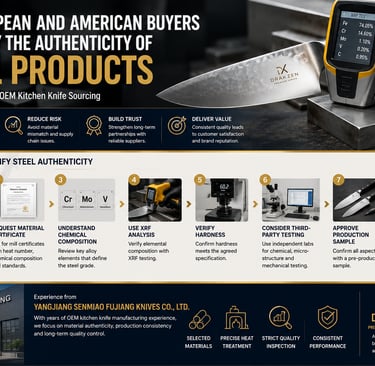
A Practical Guide for OEM Sourcing, Quality Control, and Material Verification
When sourcing kitchen knives internationally, one question appears in almost every serious purchasing discussion:
"How can we verify that the steel used in the knives is really what the supplier claims?"
This question has become even more important as global sourcing has expanded.
Today, buyers can find hundreds of suppliers offering products described as VG10, 10Cr15CoMoV, 14C28N, X50CrMoV15, or other premium stainless steels.
The challenge is that the steel grade printed on a quotation, product page, or sample report is not, by itself, proof of authenticity.
For importers, distributors, private-label brands, and sourcing managers, understanding how to verify steel authenticity is an essential part of risk management.
This guide explains practical methods that professional buyers can use before and during an OEM kitchen knife project.
Why Steel Verification Matters
Steel determines much more than marketing claims.
It directly influences:
Edge retention
Corrosion resistance
Toughness
Sharpening characteristics
Product consistency
Customer satisfaction
If the supplied material differs from the agreed specification, the final product may perform very differently from expectations.
Material verification therefore protects both product quality and brand reputation.
Step 1. Ask for the Steel Grade Before Requesting a Quotation
One common sourcing mistake is requesting only:
"Please quote this knife."
Instead, specify the material.
For example:
VG10
10Cr15CoMoV
X50CrMoV15
14C28N
5Cr15MoV
This establishes a clear technical basis for future verification.
Step 2. Request a Material Certificate
A reputable manufacturer should be able to provide documentation from the steel supplier showing the material specification.
Typical information may include:
Steel designation
Heat number or batch number
Chemical composition
Production standard
Manufacturer information
A material certificate should be viewed as supporting documentation rather than the only form of verification.
Step 3. Understand the Chemical Composition
Every steel grade has a characteristic chemical composition.
For example:
VG10
Carbon (C)
Chromium (Cr)
Molybdenum (Mo)
Vanadium (V)
Cobalt (Co)
X50CrMoV15
Carbon
Chromium
Molybdenum
Vanadium
14C28N
Carbon
Chromium
Nitrogen
Buyers do not need to memorize exact percentages.
However, understanding the principal alloying elements helps when reviewing test reports.
Step 4. Use XRF Analysis
One of the most common methods used in manufacturing is X-Ray Fluorescence (XRF) testing.
XRF analyzers identify the elemental composition of metal without damaging the blade.
They are widely used for:
Incoming material inspection
Supplier verification
Quality control
Third-party inspection
XRF can confirm whether the material generally matches the declared alloy family.
However, it has limitations and should not be interpreted as a complete metallurgical evaluation.
Step 5. Verify Hardness Separately
Steel authenticity and hardness are different topics.
Even genuine VG10 can perform poorly if the heat treatment is incorrect.
Buyers should request hardness verification using the agreed testing method.
Hardness confirms process control rather than material identity.
Both material verification and heat-treatment verification are necessary.
Step 6. Consider Independent Laboratory Testing
For high-value OEM projects, independent testing can provide additional confidence.
Laboratories may perform:
Chemical analysis
Metallographic examination
Hardness testing
Corrosion evaluation
Mechanical testing
Third-party verification is particularly useful when developing premium private-label products.
Step 7. Compare Samples Before Mass Production
A production sample should represent:
Steel
Heat treatment
Blade geometry
Surface finish
Logo
Packaging
Once approved, it should become the reference for mass production.
Material verification is much more meaningful when combined with sample approval.
Step 8. Evaluate the Manufacturer's Quality System
Material authenticity depends not only on testing.
It also depends on manufacturing management.
Professional buyers may ask:
How are incoming materials identified?
How are batches recorded?
Are different steels stored separately?
Is traceability maintained?
Are inspection records retained?
A well-organized quality system reduces the risk of material mix-ups.
Lessons from OEM Kitchen Knife Manufacturing
Through OEM manufacturing projects at Yangjiang Senmiao Fujiang Knives Co., Ltd., one lesson has become increasingly clear:
Buyers who focus only on the steel name often overlook the manufacturing system behind that material.
The most productive discussions usually include questions about:
Material sourcing
Heat treatment
Inspection procedures
Batch traceability
Production consistency
Rather than relying on a single document, successful verification combines supplier transparency, documented processes, approved samples, and appropriate testing methods.
How DRAKZEN Applies This Philosophy
The product-development philosophy behind DRAKZEN is built on three principles:
Precision. Reliability. Craftsmanship.
When evaluating steel authenticity, those principles translate into practical actions.
Precision means defining the required material clearly.
Reliability means maintaining traceability throughout production.
Craftsmanship means combining correct materials with appropriate heat treatment, grinding, and inspection to achieve consistent performance.
Steel Verification Checklist for Buyers
Before approving an OEM kitchen knife order, consider confirming:
Steel grade
Material certificate
Supplier information
Heat number or batch identification
Chemical composition
XRF verification (when appropriate)
Hardness test
Approved production sample
Batch traceability
Quality-control records
Third-party inspection requirements
Frequently Asked Questions
Can a material certificate alone prove steel authenticity?
A material certificate provides valuable information but is generally most effective when considered together with traceability, inspection records, approved samples, and, where appropriate, independent testing.
Does XRF testing identify every aspect of knife quality?
No.
XRF primarily analyzes elemental composition.
Knife performance also depends on heat treatment, blade geometry, grinding, finishing, and manufacturing quality.
Should buyers perform third-party testing?
For large orders, new suppliers, or premium private-label products, independent testing can be a useful additional safeguard.
The appropriate level of testing depends on the project's value and risk profile.
Can the same steel perform differently?
Yes.
Heat treatment, manufacturing processes, grinding, and quality control all influence the final performance of the knife.
Final Thoughts
Verifying steel authenticity is not about distrusting every supplier.
It is about establishing a sourcing process that reduces uncertainty.
For professional B2B buyers, the objective is not only to confirm the name of the steel but to understand how that material is sourced, verified, processed, and managed throughout production.
From our experience at Yangjiang Senmiao Fujiang Knives Co., Ltd., the most successful OEM projects are built on transparency, documented quality systems, and clear communication rather than assumptions.
The product philosophy behind DRAKZEN follows the same approach.
Choosing the correct steel is important.
Verifying it systematically is even more important.
When buyers combine material documentation, traceability, appropriate testing, approved samples, and consistent manufacturing controls, they are far more likely to receive products that meet both technical requirements and customer expectations.
we are committed to delivering top-quality kitchen knives crafted with precision and passion. Our team of expert designers and artisans blends traditional craftsmanship with modern technology to create knives that elevate your culinary experience. From custom designs to wholesale solutions, we provide exceptional products tailored to meet the needs of professional chefs, home cooks, and businesses worldwide. With a focus on durability, performance, and innovat
Phone
+86-18898413516
Copyright by @senmiaokitchen All rights
+86-18898413516


Our Services
Wholesale customization
OEM
Dropshipping
Brand processing
Useful Link
About us
Our Team
Contact Us
Email subscription
Stay Sharp, Stay Ahead – Subscribe for Exclusive Offers and Kitchen Tips!
Company Name:阳江市森妙福匠刀具有限责任公司
By submitting this form you agree to our Privacy Policy.